

-
1 implement a process
организовывать (термодинамический) процесс; аппаратно оснащать процессline process — отработанный процесс; отработанная технология
English-Russian dictionary on nuclear energy > implement a process
-
2 implement a process
Экономика: осуществлять процесс -
3 to implement a process
English-russian dctionary of contemporary Economics > to implement a process
-
4 process
1. n1) процесс2) способ; метод3) технологический процесс; режим
- accounting process
- acquisition process
- adjustment process
- automated process
- averaging process
- bargaining process
- basic process
- branching process
- budgeting process
- capital intensive manufacturing process
- circular process
- complex process
- continuous process
- continuous flow process
- controlled process
- cumulative process
- current production process
- cyclic process
- data-generating process
- decision process
- decision-making process
- deterministic process
- due process of law
- earning process
- economical process
- energy-saving technological process
- engineering process
- evening-up process
- evolutionary process
- fabrication process
- feasible process
- finishing process
- flow process
- growth process
- immigration process
- improved process
- industrial process
- industrialization process
- industrially applicable process
- inflationary process
- innovation process
- labour process
- labour-intensive process
- launching process
- licensed process
- low-waste process
- manufacturing process
- material production process
- material-saving technological process
- money accumulation process
- multistage process
- operating process
- paperwork process
- patented process
- pilot process
- price calculating process
- price calculation process
- privatization process
- production process
- productive process
- random process
- renewal process
- replenishment process
- reproduction process
- reproductive process
- screening process
- search process
- service process
- stationary process
- storage process
- technological process
- time-dependent process
- waste-free technological process
- process of circulation
- process of creating value
- process of development
- process of manufacture
- process of manufacturing
- process of production
- be in the process of
- develop a process
- evaluate a process
- implement a process
- license a process
- master a process
- operate a process
- patent a process
- practise a process
- work out a process2. v1) обрабатывать, перерабатывать2) оформлять (документы)3) юр. возбуждать делоEnglish-russian dctionary of contemporary Economics > process
-
5 implement
1) орудие
2) реализовать
3) снаряд
4) снарядный
– draining implement
– farm implement
– front-mounted implement
– implement process
– mid-mounted implement
– moldboard implement
– mount an implement
– mounted implement
– rear-mounted implement
– trailed implement
– wide-cut implement -
6 process
1) процесс
2) обработать
3) перерабатывать
4) движение
5) течение
6) прием
7) способ
8) обрабатывать
9) процедура
10) технологический
11) обрабатывающий
12) вычислительный
– activate a process
– additive process
– adiabatic process
– adjoint process
– aluninography process
– anaerobic process
– auxiliary process
– averaging process
– batch process
– Bessemer process
– bloomery process
– branching process
– commercialize a process
– computational process
– continuous process
– controlled process
– converter process
– correlated process
– counter-flow process
– Crouse process
– cupola process
– decision process
– denumerable process
– destroy a process
– deterministic process
– diagonal process
– diffusion process
– doping process
– dry-press process
– EFG process
– emigration process
– endothermic process
– equally-correlated process
– equilibrium process
– ergodic process
– exhaustion process
– exothermic process
– explosive process
– fit process adequately
– hereditary process
– ideal process
– immigration process
– implement process
– input process
– install process
– inverse process
– irreversible process
– isentropic process
– isobaric process
– isochoric process
– isothermal process
– iterative process
– Kroll process
– limit process
– Markov process
– martingale process
– Moebius process
– non-steady process
– nonequilibrium process
– nonpreemptive process
– open-hearth process
– optimal process
– Orbach process
– oxidizing process
– path of a process
– periodic process
– pig-and-ore process
– preemptive process
– probabilistic process
– process acid
– process camera
– process chart
– process condensate
– process data
– process design
– process engineering
– process feed
– process film
– process gas
– process information
– process installation
– process interface
– process liquid
– process liquor
– process load
– process occurs
– process of exhaustion
– process oil
– process oxygen
– process runs
– process steam
– process the rubber
– process variable
– process water
– production process
– random process
– rate process
– reduction process
– regular process
– repetitive process
– reproduce process
– reverberatory process
– reversible process
– rotor process
– sequential process
– soft-mud process
– stationary process
– steady-state process
– steel-making process
– stencil process
– stochastic process
– transient process
– transport process
– umklapp process
– unit process
– unsteady process
– welding process
– Wohlwill process
– xiphoid process
birth and death process — <math.> процесс рождения и гибели
chromizing by powder process — твердое диффузионное хромирование
disturbed harmonic process — возмущенный гармонический процесс
drawn-gate CMOS process — технология КМОП-схем с удлиненными затворами
realization of random process — реализация случайного процесса
strictly stationary process — стационарный в узком смысле процесс
-
7 implement process
-
8 seven-step improvement process
семишаговый процесс совершенствования
(ITIL Continual Service Improvement)
Процесс, отвечающий за определение и контроль исполнения шагов, необходимых для идентификации, определения, сбора, обработки, анализа, представления и внедрения улучшений. Этот процесс постоянно оценивает работу поставщика ИТ-услуг и совершенствование процессов, ИТ-услуг и ИТ-инфраструктуры для увеличения результативности и эффективности (в том числе, с точки зрения затрат). Возможности для улучшения записываются и контролируются в реестре CSI.
[Словарь терминов ITIL версия 1.0, 29 июля 2011 г.]EN
seven-step improvement process
(ITIL Continual Service Improvement)
The process responsible for defining and managing the steps needed to identify, define, gather, process, analyse, present and implement improvements. The performance of the IT service provider is continually measured by this process and improvements are made to processes, IT services and IT infrastructure in order to increase efficiency, effectiveness and cost effectiveness. Opportunities for improvement are recorded and managed in the CSI register.
[Словарь терминов ITIL версия 1.0, 29 июля 2011 г.]Тематики
EN
Англо-русский словарь нормативно-технической терминологии > seven-step improvement process
-
9 оформлять процесс аппаратурно
implement processБольшой англо-русский и русско-английский словарь > оформлять процесс аппаратурно
-
10 management pack
пакет управления (в Service Manager 2010)
Набор классов, рабочих процессов, представлений, форм, отчетов и знаний, добавляющий в Service Manager сведения, необходимые для полной или частичной реализации процесса управления услугами. Например, пакет управления инцидентами содержит необходимые сведения, позволяющие реализовать в Service Manager процесс управления инцидентами.
[ http://systemscenter.ru/scsm_help.ru/]EN
management pack
A grouping of classes, workflows, views, forms, reports, and knowledge that extends Service Manager with the information necessary to implement all or part of a service management process. For example, the Incident management pack provides the necessary information to enable Service Manager to implement the incident management process.
[ http://systemscenter.ru/scsm_help.ru/]Тематики
EN
Англо-русский словарь нормативно-технической терминологии > management pack
-
11 Artificial Intelligence
In my opinion, none of [these programs] does even remote justice to the complexity of human mental processes. Unlike men, "artificially intelligent" programs tend to be single minded, undistractable, and unemotional. (Neisser, 1967, p. 9)Future progress in [artificial intelligence] will depend on the development of both practical and theoretical knowledge.... As regards theoretical knowledge, some have sought a unified theory of artificial intelligence. My view is that artificial intelligence is (or soon will be) an engineering discipline since its primary goal is to build things. (Nilsson, 1971, pp. vii-viii)Most workers in AI [artificial intelligence] research and in related fields confess to a pronounced feeling of disappointment in what has been achieved in the last 25 years. Workers entered the field around 1950, and even around 1960, with high hopes that are very far from being realized in 1972. In no part of the field have the discoveries made so far produced the major impact that was then promised.... In the meantime, claims and predictions regarding the potential results of AI research had been publicized which went even farther than the expectations of the majority of workers in the field, whose embarrassments have been added to by the lamentable failure of such inflated predictions....When able and respected scientists write in letters to the present author that AI, the major goal of computing science, represents "another step in the general process of evolution"; that possibilities in the 1980s include an all-purpose intelligence on a human-scale knowledge base; that awe-inspiring possibilities suggest themselves based on machine intelligence exceeding human intelligence by the year 2000 [one has the right to be skeptical]. (Lighthill, 1972, p. 17)4) Just as Astronomy Succeeded Astrology, the Discovery of Intellectual Processes in Machines Should Lead to a Science, EventuallyJust as astronomy succeeded astrology, following Kepler's discovery of planetary regularities, the discoveries of these many principles in empirical explorations on intellectual processes in machines should lead to a science, eventually. (Minsky & Papert, 1973, p. 11)5) Problems in Machine Intelligence Arise Because Things Obvious to Any Person Are Not Represented in the ProgramMany problems arise in experiments on machine intelligence because things obvious to any person are not represented in any program. One can pull with a string, but one cannot push with one.... Simple facts like these caused serious problems when Charniak attempted to extend Bobrow's "Student" program to more realistic applications, and they have not been faced up to until now. (Minsky & Papert, 1973, p. 77)What do we mean by [a symbolic] "description"? We do not mean to suggest that our descriptions must be made of strings of ordinary language words (although they might be). The simplest kind of description is a structure in which some features of a situation are represented by single ("primitive") symbols, and relations between those features are represented by other symbols-or by other features of the way the description is put together. (Minsky & Papert, 1973, p. 11)[AI is] the use of computer programs and programming techniques to cast light on the principles of intelligence in general and human thought in particular. (Boden, 1977, p. 5)The word you look for and hardly ever see in the early AI literature is the word knowledge. They didn't believe you have to know anything, you could always rework it all.... In fact 1967 is the turning point in my mind when there was enough feeling that the old ideas of general principles had to go.... I came up with an argument for what I called the primacy of expertise, and at the time I called the other guys the generalists. (Moses, quoted in McCorduck, 1979, pp. 228-229)9) Artificial Intelligence Is Psychology in a Particularly Pure and Abstract FormThe basic idea of cognitive science is that intelligent beings are semantic engines-in other words, automatic formal systems with interpretations under which they consistently make sense. We can now see why this includes psychology and artificial intelligence on a more or less equal footing: people and intelligent computers (if and when there are any) turn out to be merely different manifestations of the same underlying phenomenon. Moreover, with universal hardware, any semantic engine can in principle be formally imitated by a computer if only the right program can be found. And that will guarantee semantic imitation as well, since (given the appropriate formal behavior) the semantics is "taking care of itself" anyway. Thus we also see why, from this perspective, artificial intelligence can be regarded as psychology in a particularly pure and abstract form. The same fundamental structures are under investigation, but in AI, all the relevant parameters are under direct experimental control (in the programming), without any messy physiology or ethics to get in the way. (Haugeland, 1981b, p. 31)There are many different kinds of reasoning one might imagine:Formal reasoning involves the syntactic manipulation of data structures to deduce new ones following prespecified rules of inference. Mathematical logic is the archetypical formal representation. Procedural reasoning uses simulation to answer questions and solve problems. When we use a program to answer What is the sum of 3 and 4? it uses, or "runs," a procedural model of arithmetic. Reasoning by analogy seems to be a very natural mode of thought for humans but, so far, difficult to accomplish in AI programs. The idea is that when you ask the question Can robins fly? the system might reason that "robins are like sparrows, and I know that sparrows can fly, so robins probably can fly."Generalization and abstraction are also natural reasoning process for humans that are difficult to pin down well enough to implement in a program. If one knows that Robins have wings, that Sparrows have wings, and that Blue jays have wings, eventually one will believe that All birds have wings. This capability may be at the core of most human learning, but it has not yet become a useful technique in AI.... Meta- level reasoning is demonstrated by the way one answers the question What is Paul Newman's telephone number? You might reason that "if I knew Paul Newman's number, I would know that I knew it, because it is a notable fact." This involves using "knowledge about what you know," in particular, about the extent of your knowledge and about the importance of certain facts. Recent research in psychology and AI indicates that meta-level reasoning may play a central role in human cognitive processing. (Barr & Feigenbaum, 1981, pp. 146-147)Suffice it to say that programs already exist that can do things-or, at the very least, appear to be beginning to do things-which ill-informed critics have asserted a priori to be impossible. Examples include: perceiving in a holistic as opposed to an atomistic way; using language creatively; translating sensibly from one language to another by way of a language-neutral semantic representation; planning acts in a broad and sketchy fashion, the details being decided only in execution; distinguishing between different species of emotional reaction according to the psychological context of the subject. (Boden, 1981, p. 33)Can the synthesis of Man and Machine ever be stable, or will the purely organic component become such a hindrance that it has to be discarded? If this eventually happens-and I have... good reasons for thinking that it must-we have nothing to regret and certainly nothing to fear. (Clarke, 1984, p. 243)The thesis of GOFAI... is not that the processes underlying intelligence can be described symbolically... but that they are symbolic. (Haugeland, 1985, p. 113)14) Artificial Intelligence Provides a Useful Approach to Psychological and Psychiatric Theory FormationIt is all very well formulating psychological and psychiatric theories verbally but, when using natural language (even technical jargon), it is difficult to recognise when a theory is complete; oversights are all too easily made, gaps too readily left. This is a point which is generally recognised to be true and it is for precisely this reason that the behavioural sciences attempt to follow the natural sciences in using "classical" mathematics as a more rigorous descriptive language. However, it is an unfortunate fact that, with a few notable exceptions, there has been a marked lack of success in this application. It is my belief that a different approach-a different mathematics-is needed, and that AI provides just this approach. (Hand, quoted in Hand, 1985, pp. 6-7)We might distinguish among four kinds of AI.Research of this kind involves building and programming computers to perform tasks which, to paraphrase Marvin Minsky, would require intelligence if they were done by us. Researchers in nonpsychological AI make no claims whatsoever about the psychological realism of their programs or the devices they build, that is, about whether or not computers perform tasks as humans do.Research here is guided by the view that the computer is a useful tool in the study of mind. In particular, we can write computer programs or build devices that simulate alleged psychological processes in humans and then test our predictions about how the alleged processes work. We can weave these programs and devices together with other programs and devices that simulate different alleged mental processes and thereby test the degree to which the AI system as a whole simulates human mentality. According to weak psychological AI, working with computer models is a way of refining and testing hypotheses about processes that are allegedly realized in human minds.... According to this view, our minds are computers and therefore can be duplicated by other computers. Sherry Turkle writes that the "real ambition is of mythic proportions, making a general purpose intelligence, a mind." (Turkle, 1984, p. 240) The authors of a major text announce that "the ultimate goal of AI research is to build a person or, more humbly, an animal." (Charniak & McDermott, 1985, p. 7)Research in this field, like strong psychological AI, takes seriously the functionalist view that mentality can be realized in many different types of physical devices. Suprapsychological AI, however, accuses strong psychological AI of being chauvinisticof being only interested in human intelligence! Suprapsychological AI claims to be interested in all the conceivable ways intelligence can be realized. (Flanagan, 1991, pp. 241-242)16) Determination of Relevance of Rules in Particular ContextsEven if the [rules] were stored in a context-free form the computer still couldn't use them. To do that the computer requires rules enabling it to draw on just those [ rules] which are relevant in each particular context. Determination of relevance will have to be based on further facts and rules, but the question will again arise as to which facts and rules are relevant for making each particular determination. One could always invoke further facts and rules to answer this question, but of course these must be only the relevant ones. And so it goes. It seems that AI workers will never be able to get started here unless they can settle the problem of relevance beforehand by cataloguing types of context and listing just those facts which are relevant in each. (Dreyfus & Dreyfus, 1986, p. 80)Perhaps the single most important idea to artificial intelligence is that there is no fundamental difference between form and content, that meaning can be captured in a set of symbols such as a semantic net. (G. Johnson, 1986, p. 250)Artificial intelligence is based on the assumption that the mind can be described as some kind of formal system manipulating symbols that stand for things in the world. Thus it doesn't matter what the brain is made of, or what it uses for tokens in the great game of thinking. Using an equivalent set of tokens and rules, we can do thinking with a digital computer, just as we can play chess using cups, salt and pepper shakers, knives, forks, and spoons. Using the right software, one system (the mind) can be mapped into the other (the computer). (G. Johnson, 1986, p. 250)19) A Statement of the Primary and Secondary Purposes of Artificial IntelligenceThe primary goal of Artificial Intelligence is to make machines smarter.The secondary goals of Artificial Intelligence are to understand what intelligence is (the Nobel laureate purpose) and to make machines more useful (the entrepreneurial purpose). (Winston, 1987, p. 1)The theoretical ideas of older branches of engineering are captured in the language of mathematics. We contend that mathematical logic provides the basis for theory in AI. Although many computer scientists already count logic as fundamental to computer science in general, we put forward an even stronger form of the logic-is-important argument....AI deals mainly with the problem of representing and using declarative (as opposed to procedural) knowledge. Declarative knowledge is the kind that is expressed as sentences, and AI needs a language in which to state these sentences. Because the languages in which this knowledge usually is originally captured (natural languages such as English) are not suitable for computer representations, some other language with the appropriate properties must be used. It turns out, we think, that the appropriate properties include at least those that have been uppermost in the minds of logicians in their development of logical languages such as the predicate calculus. Thus, we think that any language for expressing knowledge in AI systems must be at least as expressive as the first-order predicate calculus. (Genesereth & Nilsson, 1987, p. viii)21) Perceptual Structures Can Be Represented as Lists of Elementary PropositionsIn artificial intelligence studies, perceptual structures are represented as assemblages of description lists, the elementary components of which are propositions asserting that certain relations hold among elements. (Chase & Simon, 1988, p. 490)Artificial intelligence (AI) is sometimes defined as the study of how to build and/or program computers to enable them to do the sorts of things that minds can do. Some of these things are commonly regarded as requiring intelligence: offering a medical diagnosis and/or prescription, giving legal or scientific advice, proving theorems in logic or mathematics. Others are not, because they can be done by all normal adults irrespective of educational background (and sometimes by non-human animals too), and typically involve no conscious control: seeing things in sunlight and shadows, finding a path through cluttered terrain, fitting pegs into holes, speaking one's own native tongue, and using one's common sense. Because it covers AI research dealing with both these classes of mental capacity, this definition is preferable to one describing AI as making computers do "things that would require intelligence if done by people." However, it presupposes that computers could do what minds can do, that they might really diagnose, advise, infer, and understand. One could avoid this problematic assumption (and also side-step questions about whether computers do things in the same way as we do) by defining AI instead as "the development of computers whose observable performance has features which in humans we would attribute to mental processes." This bland characterization would be acceptable to some AI workers, especially amongst those focusing on the production of technological tools for commercial purposes. But many others would favour a more controversial definition, seeing AI as the science of intelligence in general-or, more accurately, as the intellectual core of cognitive science. As such, its goal is to provide a systematic theory that can explain (and perhaps enable us to replicate) both the general categories of intentionality and the diverse psychological capacities grounded in them. (Boden, 1990b, pp. 1-2)Because the ability to store data somewhat corresponds to what we call memory in human beings, and because the ability to follow logical procedures somewhat corresponds to what we call reasoning in human beings, many members of the cult have concluded that what computers do somewhat corresponds to what we call thinking. It is no great difficulty to persuade the general public of that conclusion since computers process data very fast in small spaces well below the level of visibility; they do not look like other machines when they are at work. They seem to be running along as smoothly and silently as the brain does when it remembers and reasons and thinks. On the other hand, those who design and build computers know exactly how the machines are working down in the hidden depths of their semiconductors. Computers can be taken apart, scrutinized, and put back together. Their activities can be tracked, analyzed, measured, and thus clearly understood-which is far from possible with the brain. This gives rise to the tempting assumption on the part of the builders and designers that computers can tell us something about brains, indeed, that the computer can serve as a model of the mind, which then comes to be seen as some manner of information processing machine, and possibly not as good at the job as the machine. (Roszak, 1994, pp. xiv-xv)The inner workings of the human mind are far more intricate than the most complicated systems of modern technology. Researchers in the field of artificial intelligence have been attempting to develop programs that will enable computers to display intelligent behavior. Although this field has been an active one for more than thirty-five years and has had many notable successes, AI researchers still do not know how to create a program that matches human intelligence. No existing program can recall facts, solve problems, reason, learn, and process language with human facility. This lack of success has occurred not because computers are inferior to human brains but rather because we do not yet know in sufficient detail how intelligence is organized in the brain. (Anderson, 1995, p. 2)Historical dictionary of quotations in cognitive science > Artificial Intelligence
-
12 Plan-Do-Check-Act
Планирование - Выполнение - Проверка - Корректировка
PDCA
(ITIL Continual Service Improvement)
Четыре шага цикла управления процессом, разработанного Эдвардом Демингом (Edward Deming). Цикл «Планирование - Выполнение -Проверка - Корректировка» также называют циклом Деминга.
Планирование – проектирование или пересмотр процессов, поддерживающих ИТ- услуги.
Выполнение – внедрение плана и управление процессом.
Проверка – измерение процессов и ИТ-услуг, сравнение с целями и получение отчётности.
Корректировка – планирование и внедрение изменений для улучшения процессов.
[Словарь терминов ITIL версия 1.0, 29 июля 2011 г.]EN
Plan-Do-Check-Act
PDCA
(ITIL Continual Service Improvement)
A four-stage cycle for process management, attributed to Edward Deming. Plan-Do-Check-Act is also called the Deming Cycle.
Plan - design or revise processes that support the IT services;
Do - implement the plan and manage the processes;
Check - measure the processes and IT services, compare with objectives and produce reports;
Act - plan and implement changes to improve the processes.
[Словарь терминов ITIL версия 1.0, 29 июля 2011 г.]Тематики
Синонимы
EN
Англо-русский словарь нормативно-технической терминологии > Plan-Do-Check-Act
-
13 PDCA
Планирование - Выполнение - Проверка - Корректировка
PDCA
(ITIL Continual Service Improvement)
Четыре шага цикла управления процессом, разработанного Эдвардом Демингом (Edward Deming). Цикл «Планирование - Выполнение -Проверка - Корректировка» также называют циклом Деминга.
Планирование – проектирование или пересмотр процессов, поддерживающих ИТ- услуги.
Выполнение – внедрение плана и управление процессом.
Проверка – измерение процессов и ИТ-услуг, сравнение с целями и получение отчётности.
Корректировка – планирование и внедрение изменений для улучшения процессов.
[Словарь терминов ITIL версия 1.0, 29 июля 2011 г.]EN
Plan-Do-Check-Act
PDCA
(ITIL Continual Service Improvement)
A four-stage cycle for process management, attributed to Edward Deming. Plan-Do-Check-Act is also called the Deming Cycle.
Plan - design or revise processes that support the IT services;
Do - implement the plan and manage the processes;
Check - measure the processes and IT services, compare with objectives and produce reports;
Act - plan and implement changes to improve the processes.
[Словарь терминов ITIL версия 1.0, 29 июля 2011 г.]Тематики
Синонимы
EN
Англо-русский словарь нормативно-технической терминологии > PDCA
-
14 development
n1) развитие; совершенствование; эволюция2) расширение; рост; подъем3) обыкн. pl явление; обстоятельство; событие; фактор; тенденция4) разработка; освоение; производство5) перемена, изменение6) подготовка; повышение квалификации•to benefit the development of smth — содействовать / способствовать развитию чего-л.; облегчать развитие чего-л.
to change the course of a country's political development — изменять ход политического развития страны
to damage development — подрывать развитие, наносить ущерб развитию
to facilitate the development of smth — содействовать / способствовать развитию чего-л., облегчать развитие чего-л.
to hamper / to hinder the development of smth — затруднять / тормозить развитие чего-л.; препятствовать развитию чего-л.
to lag behind in one's economic development — отставать в своем экономическом развитии
to promote the development of smth — содействовать / способствовать развитию чего-л.; облегчать развитие чего-л.
to put a brake on the development — сдерживать / тормозить развитие
to put spokes in the wheels of the development of smth — мешать / препятствовать развитию чего-л.
to retard development — задерживать / замедлять развитие
to step backward in one's development — делать шаг назад в своем развитии
to stimulate the development of smth — стимулировать / давать стимул развитию чего-л.
- acceleration of socioeconomic developmentto support the development of smth — поддерживать / обеспечивать развитие чего-л.
- actual developments
- advanced development
- aggregate development
- all-round development
- at all levels of development
- at such a stage of development
- balanced development
- balanced pattern of development
- community development
- comprehensive development
- constant development
- constructive development
- contemporary era of development
- continuous development
- course of historical development
- crisis-free way of development
- cultural development
- current developments
- cyclical development
- degree of economic development
- development came to a head
- development of economic relations
- development of industrial exports
- development of new technologies
- development of popular struggle
- development of science and technology
- development of the personality
- development of tourism
- development of vocational competence
- dialectical development
- discouraging developments
- disproportional development
- driving force of development
- ecological development
- economic development
- effective development
- encouraging developments
- ethical development of society
- executive management development
- experimental development
- extensive development
- final aim of development
- financing of industrial development
- foreign-policy developments
- free development
- further development
- general regularities of development
- general results of the development
- gradual development
- guidelines for the economic and social development
- health development
- human resource development
- in the light of these developments
- independent development
- industrial development
- initial stages of development
- inner sources of development
- integrated development
- intensive development
- international development
- juridical development
- key indicators of national economic development
- latest developments - long-term development
- lop-sided development
- main trend of historical development
- major development
- major problems of society's development
- manpower development
- many-sided development of relations
- natural resources development
- negative development
- new development
- objective historical development
- objective laws of development
- overall development
- pace of development
- pace of developments
- peaceful development
- political developments
- population development
- positive development
- post-war development
- priority development
- process of development
- production development
- professional development
- progressive development
- projected development
- proportional development
- rapid development
- rate of development
- recent developments
- regional development - round-up of the latest developments
- rural development
- separate development
- shocking development
- slackening of growth rates of economic development
- slow development
- slowdown of growth rates of economic development
- social aspects of development
- social development
- sovereign development
- spasmodic development
- specifics of development
- stable development - striking development
- technical development
- technological changes conducive to development
- technological development
- trend of economic development
- unbalanced development
- uneven development
- urban development
- water resources development
- watershed in the world development
- we regard the development with grave concern
- welcome developments
- world developments
- world-wide economic development -
15 PLAN
- чертить схему или диаграмму
- чертеж
- Топографический план
- планировать
- план топографический
- план (строительная документация)
- план (на строительном чертеже)
- план (в информационных технологиях)
- план
- локальная сеть с персональными ЭВМ
- локальная сеть с персональными компьютерами
локальная сеть с персональными ЭВМ
—
[Е.С.Алексеев, А.А.Мячев. Англо-русский толковый словарь по системотехнике ЭВМ. Москва 1993]Тематики
EN
локальная сеть с персональными компьютерами
—
[Л.Г.Суменко. Англо-русский словарь по информационным технологиям. М.: ГП ЦНИИС, 2003.]Тематики
EN
план
—
[ http://www.eionet.europa.eu/gemet/alphabetic?langcode=en]
план
(в экономике) — 1. Система целевых показателей развития экономической системы, функционирования конкретного объекта, а также указание на этапы и способы их достижения, распределение ресурсов, определение ожидаемых результатов и способов их использования. П. можно рассматривать как некоторую модель развития планируемого объекта. 2. Результат решения задачи планирования, содержащий как целевые показатели, так и характеристику используемых технологических способов. Каждая точка пространства производственных возможностей есть отображение некоторого плана. Поэтому вместо термина «П.», в данном смысле часто употребляют термин «точка». Процесс разработки П. называется технологией планирования. Подробнее см. Оптимальное планирование, Оптимальный план, Перспективное оптимальное планирование, Планирование, Планово-экономи¬чес¬кая задача. См. также Адаптивность плана, Маневренность плана, Надежность плана, Эффективная точка.
[ http://slovar-lopatnikov.ru/]EN
plan
A scheme of action, a method of proceeding thought out in advance. (Source: GOOD)
[http://www.eionet.europa.eu/gemet/alphabetic?langcode=en]Тематики
EN
DE
FR
план (в информационных технологиях)
Подробное предложение, которое описывает деятельность и ресурсы, необходимые для достижения цели. Например, план внедрения новой ИТ-услуги или процесса. ИСО/МЭК 20000 требует наличия плана управления для каждого процесса управления ИТ-услугами.
[Словарь терминов ITIL версия 1.0, 29 июля 2011 г.]EN
plan
A detailed proposal that describes the activities and resources needed to achieve an objective - for example, a plan to implement a new IT service or process. ISO/IEC 20000 requires a plan for the management of each IT service management process.
[Словарь терминов ITIL версия 1.0, 29 июля 2011 г.]Тематики
EN
план (на строительном чертеже)
-
[Интент]В названиях планов этажей здания или сооружения указывают отметку чистого пола или номера этажа, или обозначение соответствующей секущей плоскости.
Примеры
1 План на отм. 0,000
2 План 2-9 этажей
3 План 3-3
При выполнении части плана в названии указывают оси, ограничивающие эту часть плана.
Пример - План на отм. 0,000 между осями 1 - 8 и А - Д
Если изображение (например, план) не помещается на листе принятого формата, то его делят на несколько участков, размещая их на отдельных листах.
В этом случае на каждом листе, где показан участок изображения, приводят схему целого изображения с необходимыми координационными осями и условным обозначением (штриховкой) показанного на данном листе участка изображения в соответствии с рисунком 14.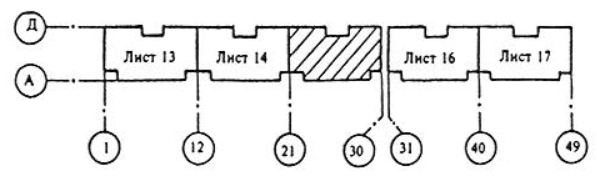
[ ГОСТ 21.101-97]
Тематики
- проектирование, документация
EN
план
Графическое масштабное изображение горизонтальной проекции или горизонтального разреза, содержащее размеры, условные обозначения, надписи и др.
[Терминологический словарь по строительству на 12 языках (ВНИИИС Госстроя СССР)]Тематики
- проектирование, документация
EN
DE
FR
план топографический
Крупномасштабный план ограниченного участка местности, в пределах которого кривизна земной поверхности не учитывается
[Терминологический словарь по строительству на 12 языках (ВНИИИС Госстроя СССР)]
топографический план
план
Картографическое изображение на плоскости в ортогональной проекции в крупном масштабе ограниченного участка местности, в пределах которого кривизна уровенной поверхности не учитывается.
[ ГОСТ 21667-76]
[ ГОСТ 22268-76]
Тематики
Обобщающие термины
Синонимы
EN
DE
FR
планировать
Выбирать объекты и цели радиоразведывательной деятельности.
[[http://www.rfcmd.ru/glossword/1.8/index.php?a=index&d=23]]Тематики
EN
чертеж
Графическое изображение предметов и их деталей, выполненное с указанием их линейных и угловых размеров, масштаба, взаимного расположения их элементов и деталей
[Терминологический словарь по строительству на 12 языках (ВНИИИС Госстроя СССР)]
чертеж
Условное графическое изображение предмета с точным соотношением его размеров, полученное методом проецирования.
[ ГОСТ Р 7.0.3-2006]Тематики
- издания, основные виды и элементы
- проектирование, документация
Обобщающие термины
EN
DE
FR
чертить схему или диаграмму
проектировать
планировать
—
[ http://slovarionline.ru/anglo_russkiy_slovar_neftegazovoy_promyishlennosti/]Тематики
Синонимы
EN
102. Топографический план
D. Plan
E. Plan
F. Plan topographique
Источник: ГОСТ 22268-76: Геодезия. Термины и определения оригинал документа
Англо-русский словарь нормативно-технической терминологии > PLAN
-
16 действие
ср.
1) action, operation театр военных действий ≈ the theatre of war/operations продление срока действия ≈ prolongation/extension of the term вводить закон в действие ≈ to implement a law, to put a law in force, to carry a law into effect, to invoke a law предоставлять кому-л. свободу действий ≈ to give smb. free hand готовый к действию ≈ effective свобода действий ≈ free play, freedom of action ближнего действия ≈ short-range военные действия ≈ military operations, hostilities штурмовые действия ≈ ground support action насильственные действия ≈ violent acts полезное действие ≈ efficiency, duty (машины) срок действия ≈ period of validity приводить в действие ≈ (что-л.) to put in action, to set going - место действия
2) (влияние) influence, effect оказывать действие под действием усиливающий действие
3) мн. действия (поведение, поступки) activity ед.;
activities;
conduct ед.;
dealing, doing сознательные действия
4) театр. act
5) мат. operation четыре действия арифметики ≈ four rules of arithmeticдействи|е - с.
1. action;
(деятельность тж.) activity;
activities pl. ;
руководство к ~ю а guide to action;
план ~й plan of action;
самовольные ~я arbitrary action(s) ;
2. (о работе механизма и т. п.) operation, functioning;
в ~и in operation;
вступать в ~ (о заводе и т. п.) come* into operation;
be* commissioned;
(о контракте) come* into force;
приходить в ~ come* into operation;
~ кишечника movement of the bowels;
3. (применение на практике) effect;
ввести закон в ~ put* the law into effect;
4. (воздействие) effect;
под ~ем under the influence;
5. (события) action;
~ происходит в Москве the scene is laid in Moscow;
6. театр. act;
пьеса в пяти ~ях five-act play;
7. мат. operation, process;
четыре ~я арифметики the four rules of arithmetic;
военные ~я hostilities;
(military) operations.Большой англо-русский и русско-английский словарь > действие
-
17 reform
1. nto be committed to economic reform — быть связанным обязательством осуществлять экономические реформы
to block reforms — блокировать реформы / проведение реформ
to bring about / to carry out / to carry through reforms — осуществлять / проводить реформы
to champion reform — выступать сторонником преобразований / реформ
to copy the reforms introduced by smb — копировать реформы, введенные кем-л.
to deliver reforms — осуществлять / проводить реформы
to derail / to disrupt reforms — срывать реформы
to effect reforms — осуществлять / проводить реформы
to endorse reforms — одобрять / утверждать реформы
to follow in the footsteps of smb's reforms — следовать примеру чьих-л. реформ
to force the pace of one's reforms — ускорять темп осуществления своих реформ
to forge ahead with political and economic reforms — вырываться вперед в деле проведения политических и экономических реформ
to implement reforms — осуществлять / проводить реформы
to initiate reforms — выступать инициатором проведения реформ; приступать к проведению реформ
to institute / to introduce reforms — выступать инициатором проведения реформ; приступать к проведению реформ
to make reforms — осуществлять / проводить реформы
to model one's reforms after those of another country — вырабатывать свои реформы по образцу реформ другой страны
to press ahead with one's reforms — настойчиво продолжать свой курс реформ
to pursue reforms — осуществлять / проводить реформы
to push (ahead) one's reforms — энергично проводить свои реформы
to push through (congress) a reform — протаскивать / проталкивать реформу ( через конгресс)
to question the pace of smb's reforms — ставить под сомнение темп проведения чьих-л. реформ
- advocate of economic reformto undertake reforms — осуществлять / проводить реформы
- agrarian reform
- backtracking from reform
- basic reforms
- blueprint for political reform
- broad program of reforms
- coherent reform of the economy
- commitment to reforms
- comprehensive reform
- constitutional reform
- constitutional reforms
- credit reforms
- currency reform
- declared aim of the reform
- democratic reforms
- depth of the reform
- drastic reforms
- economic reform
- educational reforms
- electoral reform
- far-reaching reforms
- full-blooded economic reforms
- genuine reform
- half-way reform
- impending reform
- implementation of a reform
- iniquitous reform
- internal reforms
- introduction of reforms
- land reform
- land-tenure reform
- legislative reform
- liberal reforms
- limited reform
- long-term reforms
- mainstream of reforms
- major reform
- market-oriented reforms
- market-style reforms
- mindless reform
- monetary reform
- overdue reforms
- pace of reforms should be faster
- pace of reforms - petty reforms
- planned reforms - prerequisite of reforms
- price reform
- program of reforms
- progress of reforms
- progressive reform
- promised reforms
- proponent of reforms
- radical reform
- reform goes to Parliament
- reform has entered a critical phase
- reform has virtually come to a standstill
- reform is in its infancy
- reform isn't working properly
- reform within the existing structures
- reforms are achieving real momentum
- reforms are on course
- reforms will work
- rollback of the reforms
- sabotage to reforms
- slow-down of reforms
- social reforms
- socio-economic reform
- stringiest reforms
- structural reforms
- substantial reforms
- support for reforms
- tax reform
- taxation reform
- tentative reforms
- test of reforms
- tide of reforms washing across the world
- tough reform
- urgent reforms
- wage reform
- we are long overdue for reforms
- wide-ranging reform
- wide-ranging reforms
- widespread reform 2. v -
18 roadmap
n2) план; инструкция3) (Roadmap, Roadmap for Peace) "Дорожная карта" (план по окончательному урегулированию израильско-палестинского конфликта и созданию независимого палестинского государства)4) pl "Дорожные карты" (документ по сотрудничеству России и Европейского союза в четырех общих пространствах - экономическом, внешней безопасности, гуманитарном и пространстве свободы, внутренней безопасности и правосудия)•to advance the Roadmap process — продвигать процесс "Дорожной карты"
to design the Roadmap — разрабатывать "Дорожную карту"
to implement the Roadmap — претворять в жизнь "Дорожную карту"
- enemy of the Roadmapto initiate the Roadmap foundation — положить начало "Дорожной карте"
- proponent of the Roadmap
- Roadmap foundation
- Roadmap progress -
19 policy
n 1. ком. політика; курс; стратегія; лінія поведінки; a політичний; 2. стр. поліс; страховий поліс1. напрямок діяльності, інтересів політичних партій, адміністративних рад, організацій, урядів і т. ін. для досягнення своїх цілей; 2. договір (contract) страхування, в якому фіксуються: вид покриття; умови угоди, включаючи положення про скасування; заява про виплату відшкодування тощо; календарний план, що зазначає, напр., оплату страхових внесків (premium²), період чинності угоди і т. д.═════════■═════════accounting policy облікова політика; administrative policy адміністративна політика; adjustment policy політика регулювання • політика коригування; agreed value policy страховий поліс на домовлену суму; agricultural policy аграрна політика; all loss or damage policy поліс страхування від будь-яких втрат або пошкодження; allocation policy політика розподілу ресурсів; all risk policy поліс страхування від усіх ризиків; balance-of-payments policy політика регулювання платіжного балансу; blanket policy загальний поліс; budgetary policy бюджетна політика; business policy ділова політика; commercial policy торговельна політика; company policy політика підприємства; comprehensive policy поліс всебічного страхування; construction policy страховий поліс на будівництво; contractor's all risk policy поліс страхування від усіх ризиків для підрядника; corporate policy корпоративна політика; credit policy кредитна політика; currency policy валютна політика; discount policy облікова політика • дисконтна політика; dividend policy дивідендна політика; domestic policy внутрішня політика; economic policy економічна політика; endowment policy страховий поліс на старість • страховий поліс на дожиття • страхування на випадок смерті; environmental policy політика охорони довкілля; equity-linked policy страховий поліс, прибуток з якого страхувач вкладає в різні акції; expired policy прострочений страховий поліс; export policy експортна політика; financial policy фінансова політика; fire insurance policy страховий поліс від пожежі; fiscal policy фінансова політика • бюджетна політика; floating policy генеральний поліс; foreign policy зовнішня політика; foreign exchange policy валютна політика; foreign trade policy зовнішньоторговельна політика; government policy урядова політика; government environmental policy урядова політика охорони навколишнього середовища; Green policy політика захисту довкілля; group policy групова політика; homeowner's comprehensive policy поліс комбінованого страхування домовласників; immigration policy імміграційна політика; incomes policy політика регулювання доходів; inflationary policy інфляційна політика; insurance policy страховий поліс; interest rate policy політика регулювання відсоткових ставок; internal policy внутрішня політика; international policy міжнародна політика; international monetary policy міжнародна валютна політика • міжнародна грошова політика; investment policy інвестиційна політика • страховий поліс за інвестицією; investment-linked policy страховий поліс, прибуток з якого страхувач вкладає в різні акції; lapsed policy поліс, чинність якого припинена достроково; lending policy кредитна політика; life insurance policy поліс страхування життя; management policy виконавча політика • політика керівництва; marine insurance policy поліс морського страхування; master policy груповий поліс; merchandising policy торговельна політика; mixed policy змішаний поліс; monetary policy валютна політика • грошово-кредитна політика • монетарна політика; new-for-old policy страховий поліс на заміну; open policy відкритий поліс • нетаксований поліс; open-door policy політика відкритості (рівних можливостей капіталовкладень в окремих країнах); paid-up policy оплачений поліс; participating policy поліс, який дає право участі в прибутках страхового товариства; port policy портовий страховий поліс; prices and incomes policy державна політика цін та доходів; pricing policy політика ціноутворення; procurement policy політика закупівлі; public policy громадська політика • державна політика; purchasing policy політика закупівлі; rated policy розрахований страховий поліс; replacement policy стратегія заміни (обладнання); retirement policy пенсійна політика; running policy генеральний поліс; sales policy політика збуту • політика продажу; service policy стратегія обслуговування; sinking fund policy страховий поліс за фондом сплати • страховий поліс за фондом сплати активу або пасиву • поліс амортизаційного фонду; standard policy стандартний поліс • типовий поліс; stocking policy політика створення запасів; taxation policy податкова політика; time policy поліс на термін • строковий поліс; trade policy торговельна політика; unit-linked policy страховий поліс, прибуток з якого страхувач вкладає в різні акції; unvalued policy страховий поліс без визначеної вартості; valued policy страховий поліс за встановлену суму • таксований страховий поліс; voyage policy рейсовий поліс; wagering policy страховий поліс на заставу; wages policy політика заробітної плати • політика в галузі оплати праці; wait-and-see policy вичікувальна політика═════════□═════════policy audit ревізія діяльності підприємства; policy conditions умови страхування; policy exclusion анулювання страхового полісу; policy expiration date дата закінчення терміну страхування; policy expiry date дата закінчення терміну страхування; policy free of premium поліс, в якому страхувач звільняється від сплати внесків; policy holder страхувальник • держатель страхового полісу; policy holder's capital капітал страхувальника; policy loan позика під страховий поліс; policy-making process процес здійснення політики; policy number номер страхового полісу; policy of compromise політика компромісів; policy of law правова політика; policy of low interest rates політика низьких відсоткових ставок; policy owner страхувальник • держатель страхового полісу; policy period термін страхування • термін дії страхового полісу; policy plan план діяльності; policy provisions умови страхування • умови страхового договору; policy terms умови страхування • умови страхового договору; policy tool засіб проведення політики • політичний інструмент; to amend a policy змінювати/змінити поліс; to cancel a policy скасовувати/скасувати поліс; to develop a policy опрацьовувати/опрацювати політику; to discuss a policy обговорювати/обговорити питання політики • розглядати/розглянути питання політики; to implement a policy запроваджувати/запровадити політику • здійснювати/здійснити політику; to issue a policy видавати/видати страховий поліс; to make out a policy оформляти/оформити страховий поліс; to revise a policy переглядати/переглянути політику; to support a policy підтримувати/підтримати політику; to take out a policy страхуватися/застрахуватися • одержувати/одержати страховий поліс═════════◇═════════поліс < фр. police < італ. polizza — розписка, квитанція (СІС:535) pollutionсер. забруднення; забруднення довкіллязабруднення довкілля промисловими чи хімічними відходами, що робить його непридатним і шкідливим для життя; ♦ спостерігається посилення державного контролю за рівнем забруднення довкілля, широко застосовуються штрафні санкції аж до закриття підприємств, виробництв, арешту транспортних засобів на підставі вимог чинного удосконаленого природоохоронного законодавства; здійснюється широка урядова програма оновлення технологій, глибокої переробки сировини, інформаційного забезпечення боротьби за охорону природи, зростає екологічна поінформованість людей і поліпшується екологічна культура промисловості, як результат — на ринку з'являються продукти, більш сприятливі для довкілля (environment-friendly product)═════════■═════════airborne policy повітряне забруднення • забруднення повітря; atmospheric policy атмосферне забруднення; chemical policy хімічне забруднення; environmental policy забруднення довкілля; hazardous waste policy забруднення небезпечними відходами; industrial policy промислове забруднення; long-term policy тривале забруднення; noise policy зашумленість; sewage policy забруднення стічними водами; short-term policy короткочасне забруднення; solid waste policy забруднення відходами, що не розкладаються; traffic policy забруднення від автотранспорту; visual policy візуальне забруднення довкілля • плюндрування природи плакатами, написами (на скелях тощо); waste policy забруднення відходами; water policy забруднення води; wide-spread policy поширене забруднення═════════□═════════optimal quantity of policy оптимальний обсяг забруднення; policy abatement заходи запобігання забрудненню • боротьба із забрудненням; policy of streams забруднення стоків; policy of rivers забруднення річок; policy of the sea забруднення моря; to avoid policy уникати/уникнути забруднення; to prevent policy запобігати/запобігти забрудненню; to protect from policy оберігати/оберегти від забруднення -
20 contract
1. n1) договор, соглашение, контракт2) подряд3) единица торговли на срочных биржах (стандартное соглашение о купле-продаже)
- acceptable contract
- agency contract
- aleatory contract
- arrival contract
- associate contract
- auditing contract
- awarded contract
- back contracts
- banking contract
- bare contract
- binding contract
- blanket contract
- bottomry contract
- brokerage contract
- broker's contract
- building contract
- chartering contract
- civil law contract
- classified contract
- collateral contract
- collective contract
- collective bargaining contract
- commercial contract
- commercial agency contract
- commodity contract
- compensation contract
- completion-type contract
- consensual contract
- consignment contract
- construction contract
- consultancy contract
- cost-plus-fixed-fee contract
- cost-plus-percentage-fee contract
- crosslease contract
- defense contract
- design engineering contract
- development contract
- developmental contract
- draft contract
- employment contract
- enforceable contract
- exclusive contract
- exclusive sale contract
- executed contract
- executory contract
- export contract
- financial futures contract
- fixed-price contract
- fixed-price contract with redetermination
- fixed-price redeterminable prospective contract
- fixed-term contract
- flat fee contract
- formal contract
- forward contract
- framework contract
- freight contract
- futures contract
- general contract
- general freight contract
- global contract
- government contract
- guaranteed contract
- hire contract
- hire purchase contract
- illegal contract
- implied contract
- import contract
- incentive contract
- indemnity contract
- infant's contract
- initial contract
- installment contract
- insurance contract
- interest rate contract
- labour contract
- large contract
- lease contract
- licence contract
- licensing contract
- life contract
- life insurance contract
- loading contract
- long-term contract
- lucrative contract
- maintenance contract
- management contract
- manufacturing contract
- marine insurance contract
- maritime contract
- military contract
- model contract
- money lending contract
- monopoly contract
- multilateral contract
- mutually beneficial contract
- naked contract
- nude contract
- official contract
- offset contract
- onerous contract
- open contract
- open-end contract
- operating contract
- option contract
- oral contract
- original contract
- outsourcing contract
- outstanding contract
- packing contract
- parol contract
- passage contract
- patent contract
- patent-granting contract
- period contract
- permanent rent contract
- preliminary contract
- previous contract
- prime contract
- private contract
- process-transfer contract
- procurement contract
- production sharing contract
- profitable contract
- profit-sharing contract
- public contract
- purchase contract
- purchase and sale contract
- quasi contract
- real contract
- reciprocal contract
- reciprocity contract
- reinsurance contract
- rent contract
- repair contract
- research and development contract
- risk contract
- sales contract
- salvage contract
- semi-turnkey contract
- service contract
- sham contract
- share-rental contract
- share tenancy contract
- shipment contract
- short-term contract
- simple contract
- single contract
- sold contract
- specialty contract
- spot contract
- standard contract
- stand rent contract
- stockbroker's contract
- stock-option contract
- supplementary contract
- syndicate contract
- take-and-pay contract
- take-or-pay contract
- team contract
- tenancy contract
- terminal contract
- time and materials contract
- toll contract
- total package procurement contract
- towing contract
- trade contract
- trade union contract
- turnkey contract
- tying contract
- umbrella contract
- uncompleted contract
- underwriting contract
- unfulfilled contract
- unilateral contract
- valid contract
- verbal contract
- void contract
- voidable contract
- work contract
- written contract
- yellow dog contract
- contract by deed
- contract by tender
- contract for construction
- contract for custody
- contract for delivery
- contract for freight
- contract for labour and materials
- contract for public works
- contract for purchase
- contract for a single shipment
- contract for space
- contract for technical service
- contract of affreightment
- contract of agency
- contract of annuity
- contract of carriage
- contract of consignment
- contract of employment
- contract of guarantee
- contract of indemnity
- contract of insurance
- contract of intent
- contract of novation
- contract of pledge
- contract of purchase
- contract of reinsurance
- contract of representation
- contract of sale
- contract of service
- contract of suretyship
- contract of tenancy
- contract under seal
- according to the contract
- against a contract
- as per contract
- subject to contract
- with reference to the contract
- agree on a contract
- annul a contract
- award a contract
- back out of a contract
- be under contract
- break a contract
- cancel a contract
- carry out a contract
- come under a contract
- commit a breach of contract
- complete a contract
- comply with the contract
- conclude a contract
- confirm a contract
- conform to the contract
- deliver against a contract
- depart from a contract
- draw up a contract
- enforce a contract
- enter into a contract
- execute a contract
- fulfil a contract
- finance a contract
- hold a contract
- implement a contract
- infringe a contract
- initial a contract
- levy a contract
- make a contract
- negotiate a contract
- obtain a contract
- perform a contract
- place a contract
- prepare a contract
- repudiate a contract
- rescind a contract
- renew a contract
- revise a contract
- revoke a contract
- secure a contract
- sign a contract
- stipulate by a contract
- supply against a contract
- take out an insurance contract
- tender for a contract
- terminate a contract
- violate a contract
- win a contract
- withdraw from a contract2. v2) сокращать; сокращаться
- as contractedEnglish-russian dctionary of contemporary Economics > contract
- 1
- 2
См. также в других словарях:
Process (engineering) — Process engineering refers to engineering which is collaborative and concerned with completing a project as a whole.emiconductor devicesIn the electronics industry, especially for those building ICs, some technologists can be referred to as… … Wikipedia
Implement — Implement(s) may refer to:* Implementation mdash; the process for putting a design, plan or policy into effect. * A class of tools mdash; such as farm implements or writing implements … Wikipedia
Process area (CMMI) — The latest version of Capability Maturity Model Integration (CMMI) CMMI for Development, Version 1.3 contains 22 Process Areas that describe the aspects of product development that are to be covered by organizational processes. Contents 1 Process … Wikipedia
Process management (computing) — Operating systems … Wikipedia
Process group — In POSIX conformant operating systems, a process group denotes a collection of one or more processes. Process groups are used to control the distribution of signals. A signal directed to a process group is delivered individually to all of the… … Wikipedia
Process Improvement and Management (PI&M) — Identify, analyze and improve the Key ProcessesAccording to Rummler (1996) an organization is only as good as its processes. To be able to make the necessary changes in an organization, one needs to understand the key processes of the company.… … Wikipedia
Process-data diagram — A process data diagram is a diagram that describes processes and data that act as output of these processes. On the left side the meta process model can be viewed and on the right side the meta concept model can be viewed. A process data diagram… … Wikipedia
Process (systems engineering) — See also Process (disambiguation). CPRET Systems engineering CPRET A Process Definition according to AFIS (Association Française d Ingénierie Système) dedicated to SE and open to all domains. IntroductionThe System Engineering normative documents … Wikipedia
ITIL Planning to implement service management — The planning to implement service management is a set in the Information Technology Infrastructure Library (ITIL) framework. This set is about the alignment of business needs and IT provision requirements. Besides, this set describes how to… … Wikipedia
IBM Rational Unified Process — The Rational Unified Process (RUP) is an iterative software development process framework created by the Rational Software Corporation, a division of IBM since 2003. RUP is not a single concrete prescriptive process, but rather an adaptable… … Wikipedia
Bologna process — The purpose of the Bologna process (or Bologna accords) is to create the European higher education area by making academic degree standards and quality assurance standards more comparable and compatible throughout Europe, in particular under the… … Wikipedia
